

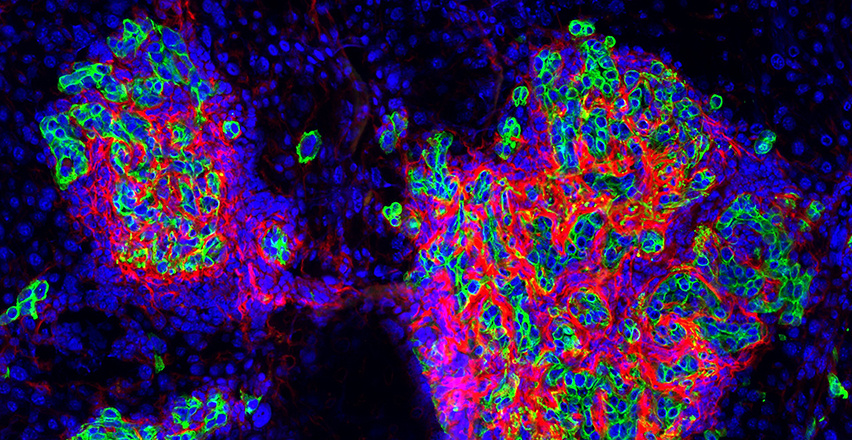
In order to grow or spread, cancer cells break down surrounding tissue using specialized enzymes called proteases. The Bhatia Lab designs nanoscale sensors to measure protease activity in highly specific locations. In the image of bile duct tumors, nanoprobes highlight patchworks of cancer cells (red), but not healthy liver tissue (blue). This technology offers scientists new strategies for visualizing the biology of cancer and may give clinicians a highly sensitive tool to detect cancer cells and assess their response to treatment. Credit: Jesse Kirkpatrick, Janvi Huria, Pinzhu Huang, Qian Zhong, Disha Badlani, Yury Popov
Scientific Program 1: Systems Biology & Engineering for Precision Cancer Medicine

The genetics and cellular processes critical to cancer therapy response differ among cancer types and individual patients, and within a single tumor. This program establishes a robust research pipeline able to elucidate and address these variations, integrating scientific and engineering expertise across to develop comprehensive solutions for cancer diagnostics and therapeutics.
Program members engage in long-term, collaborative efforts to deploy nanosensors and optics to detect and monitor cancer, target cancer with novel compounds, materials, and delivery platforms, and interpret responses to cancer therapies with systems biology and AI and machine learning tools.