

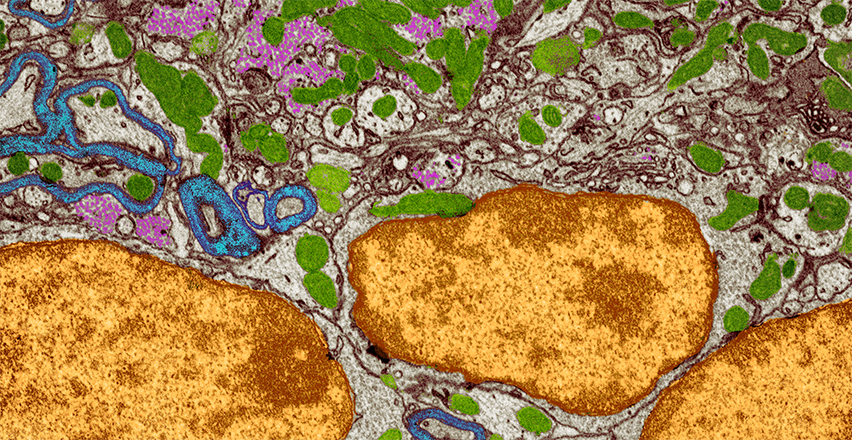
Here, breast cancer cells have spread through the bloodstream to form a tumor in the brain—an organ drastically different from their original environment. By understanding the way these cells adapt for survival and growth, researchers are better able to tailor innovative treatments for cancer metastases. Credit: Christopher Ng, Keene Abbott, Gong-Her Wu
Scientific Program 3: Molecular Cancer Biology & Physiology
Program 3 elucidates the molecular and cellular processes that influence tumor cell biology and enable disease progression, applying innovative science, engineering, and computational approaches to study cancer-associated mechanisms across biological scales, from molecules to tissues. Leveraging our strengths in studying the regulation of gene expression, along with advanced single cell technologies, organoid modeling, and high-resolution microscopy, Program 3 employs an interdisciplinary toolkit to uncover the fundamental principles underlying cancer, primarily molecular mechanisms and cell state and tissue dynamics.
NCI support enables Program 3 faculty members to mobilize resources (such as the SBC Core Facilities), organize collaborative projects, attract talented engineers and scientists with diverse research skills and perspectives, and support endeavors that accelerate discovery-to-translation pipelines. The long-term goal of Program 3 is to understand how cancers behave at every level of analysis, and then to apply those mechanistic principles for applications in cancer medicine.
Program Co-Leaders
Associate Program Leader