News

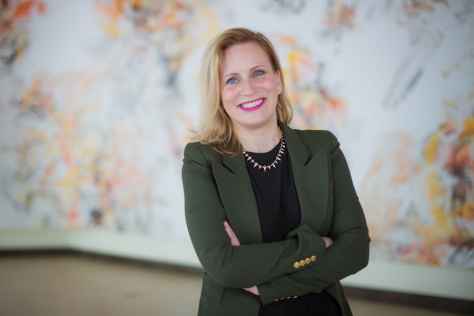
Photo of Tyler Jacks standing in front of a wall of colorful scientific images in the Koch Institute lobby and smiling for the camera.

Tyler Jacks Receives ACS Medal of Honor

American Cancer Society

Congratulations to Koch Institute Founding Director Tyler Jacks, who has been selected to receive the 2026 American Cancer Society Medal of Honor. The organization’s highest honor, this award is given to individuals whose work has fundamentally advanced the fight against cancer. Jacks is recognized for his extraordinary scientific contributions to the field of cancer biology as well as his leadership in shaping new, more effective models for collaborative, patient-centered research at MIT, non-profit Break Through Cancer, and the national level. 

Filter by

Filter by Title/Description

Filter by Topic

Filter by Year

Primed for success

Harvard-MIT Health Sciences and Technology

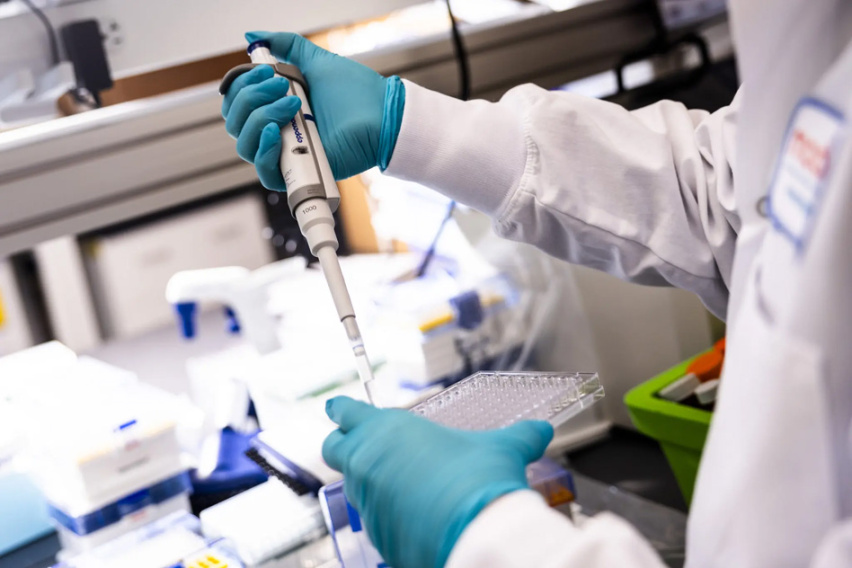
Carmen Martin Alonso, 2024 HST graduate, has been awarded a provisional patent for her liquid biopsy priming agents developed in the labs of Sangeeta Bhatia, Chris Love, and the Broad Institute's Viktor Adalsteinsson. Alonso’s priming agents make it easier to detect circulating tumor DNA in blood samples, which could enable earlier cancer diagnosis and help guide treatment.   

A SMART way to produce (CAR)T-cells

MIT News

Michael Birnbaum and researchers at the Singapore-MIT Alliance for Research & Technology Centre (SMART) have discovered a way to produce CAR T-cells for the treatment of cancer. The technology, which uses a microfluidic chip roughly the size of a pack of cards, could lower manufacturing costs for cell therapies and enable point-of-care CAR T-cell production in hospitals. 

Stark wins V Scholar Award

V Foundation

Congratulations to Jessica Stark, one of a class of 15 recipients selected as part of the V Foundation’s A Grant of Her Own: The Women Scientists Innovation Award for Cancer Research, aimed at addressing longstanding gender disparities in research. Stark studies the interplay between the immune system and glycans—cell surface sugars—and how to leverage it to improve cancer immunotherapy.

Deciphering T cell diversity

MIT News

MIT News profiled Michael Birnbaum’s efforts to develop large scale screening tools to decipher how diverse T cells recognize their targets. Birnbaum co-founded Kelonia, which is adapting the approach to reprogram T cells to target specific antigens directly inside the body to treat a broad range of diseases including cancer, autoimmune disorders, and viral infections.  

Cutting out CRISPR bias

Broad Institute

A Nature Communications study from the Boehm Group and Broad Institute collaborators highlights an ancestry bias that can cause CRISPR screens to miss cancer dependencies. To help address this bias, which stems from the guide RNAs used, the team built a website of data tools to help researchers determine the effect of ancestry on specific guides. Ongoing work by Boehm, Francisco Sánchez-Rivera, and collaborators is supported by the Bridge Project.  

DINO-mite DNA polymers

MIT News

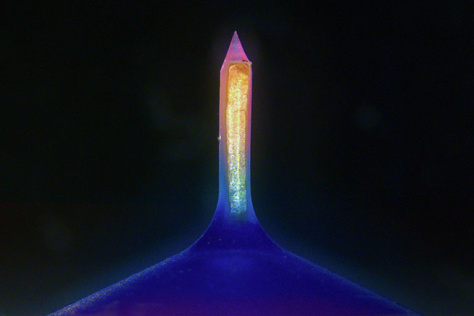
Inspired partly by the movie “Jurassic Park,” the Johnson Lab has developed an amber-like DNA-encapsulating polymer dubbed T-REX (Thermoset-REinforced Xeropreservation), for freezer-free long-term DNA storage. DNA itself has vast storage capacity that can accommodate genetic and digital data—everything from an entire human genome to the Jurassic Park theme song.

Langer named Kavli Laureate

MIT News

Congratulations to Robert Langer, who received a 2024 Kavli Prize in Nanoscience! The award recognizes his innovations in engineered  nanomaterials for the controlled release of drugs and nanoparticles for the delivery of vaccines. Langer’s work has had immense impact on the treatment of a range of diseases including cancer and schizophrenia and was instrumental in the development of mRNA vaccines.   Watch the video of Langer accepting the prize. 

Catalyzing scholarly engagement

MIT News

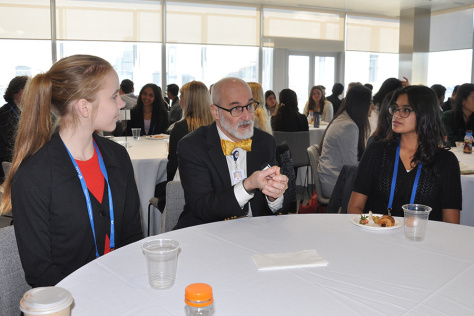
Jacks Lab alum Rodrigo Romero took part in the 2024 Catalyst Symposium, a three-day event hosted by the Department of Biology and the Picower Institute for Memory designed to promote engagement among MIT scholars and postdocs who excel in their field and are from backgrounds traditionally underrepresented in science. Romero presented his work on lineage plasticity in the tumor microenvironment.

An enhanced view of gene transcription

MIT News

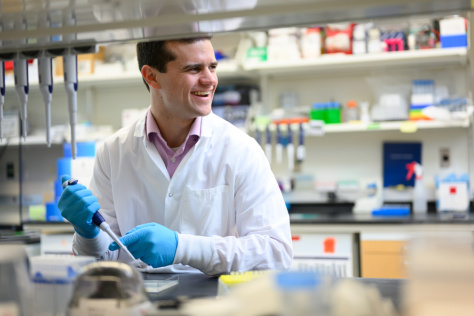
Regulating when genes are expressed, enhancers are promising drug targets for genetic disorders—when researchers can find them. Enhancers can reside far from the genes they regulate and leave only tiny amounts of eDNA, short-lived clues to their activation. Sharp Lab researchers led by postdoc D.B. Jay Mahat invented a technique, described in Nature, to facilitate eDNA isolation and observe coordination of gene expression and enhancer activation.

This work was supported in part by the Emerald Foundation.

Kinase atlas complete

MIT News

In a new Nature paper, the Yaffe Lab and collaborators map tyrosine kinase enzymes to their targets. This study, partly supported by the Charles and Marjorie Holloway Foundation and the L. Scott Ritterbush fund, builds on recent work mapping the other major kinase families to form a complete kinase atlas. This tool will enable researchers to map cell signaling pathways with unprecedented speed and detail, uncovering new biological insights and therapeutic targets for cancer.