News

Astrellas and KI researchers stand together in Astrellas Looby

MIT welcomes Astellas to the BioConvergence Cancer Alliance 

The Koch Institute announced that Astellas Pharma has joined the BioConvergence Cancer Alliance. As a member of the alliance, Astellas will closely engage with a thriving research community at the Koch Institute and flagship initiatives, as well as explore opportunities for formal scientific collaborations with faculty members at the Institute.

Filter by

Filter by Title/Description

Filter by Topic

Filter by Year

Lumicell lights the way to better patient outcomes

MIT News

Residual cancer cells can lead to costly and invasive additional treatments, drive disease relapse and progression, and worsen patient quality of life and survival. Lumicell has developed a cost effective, real-time imaging system for eliminating even single residual cancer cells during surgery and will greatly improve patient outcomes. Piloted with seed funding from the Koch Institute Frontier Research Program, the technology was FDA-approved earlier this year.

Bodyguard turns killer

MIT News

The Horvitz Lab published a study in Science Advances that helps resolve a longstanding mystery. The researchers reveal a surprising mechanistic aspect of the double life of CED-9, a protein that acts as both a protector and an killer in cell death in the roundworm Caenorhabditis elegans, with a human counterpart linked to neurodegenerative diseases and cancers.

 A blueprint for better cancer immunotherapies

MIT News

Checkpoint blockade immunotherapies (ICB) work best against cancers where most cells express similar sets of targetable antigens. Most tumors instead comprise a variety of cell types and resist these therapies.

A KI team led by Stefani Spranger connected tumor antigen architectures to immune responses. Their findings, published in Journal for the ImmunoTherapy of Cancer, enabled the team to build an RNA-based vaccine that combined with ICB for effective tumor control in mouse models of lung cancer.

Rhoda Zhang Wins 2024 Collegiate Inventors Competition

MIT News

Graduate student Linzixuan (Rhoda) Zhang has won the 2024 Collegiate Inventors Competition in both the Graduate and People's Choice categories. With advisors Robert Langer and Ana Jaklenec, Zhang and KI postdoc Xin Yang are developing metal-organic frameworks and other safe, sustainable nutrient stabilizing materials to address global micronutrient deficiencies. They are also launching MOFe™ Coffee, the first iron-fortified coffee.

ROS-y outlook for novel immune approach

MIT Koch Institute

Researchers in the Wittrup lab have developed an approach, published in Molecular Cancer Therapeutics, that uses reactive oxygen species-induced cancer cell death to help jumpstart anti-tumor immune responses and synergize with existing immunotherapies for improved treatment of many solid tumor types.     Reactive oxygen species are naturally occurring highly reactive chemical molecules formed from diatomic oxygen (O2), water, and hydrogen peroxide. These molecules act as biochemical switches that turn biological processes on and off, including certain cell death and immune functions.

Network news

MIT News

Using probabalistic networks, the Lauffenburger Lab built a computational method that will help make sense of the vast amounts of data generated by genomic, proteomic, and other research approaches. Deployed in a Cell Systems study to model tuberculosis vaccines, researchers are currently using the approach to examine the tumor's microenvironment and its response to different therapies.

Picture perfect

MIT News

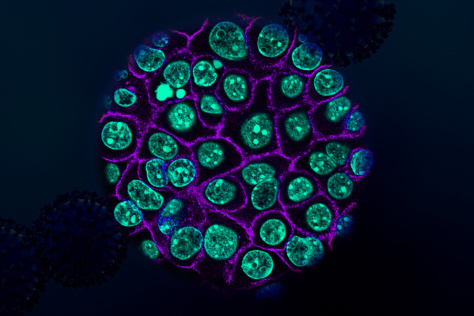
Laura Kiessling and Edward Boyden have increased the power of expansion microscopy to the nanoscale, providing a cost-effective and accessible alternative to expensive super-resolution microscopes. The technique, featured in Nature Methods, is a single step, 20-fold expansion of tissue, rendering nanoscale features of cells—such as organelles or large proteins—visible with a conventional light microscope.
 

Dual defense against tumors

MIT News

Implantable microparticles engineered by Ana Jaklenec, Angela Belcher, and Robert Langer deliver phototherapy and chemotherapy simultaneously to fight aggressive tumors. Phototherapy, a newer therapy type, uses particles heated by a laser to target and destroy tumor cells while preserving surrounding tissue. In an ACS Nano study of mice, the team's microparticles completely eliminated tumors while reducing side effects from chemotherapy and significantly prolonging survival.

This research was funded in part by the Mazumdar-Shaw International Oncology Fellowship.
 

Matthew Vander Heiden elected to National Academy of Medicine

MIT News

Congratulations to Koch Institute Director Matthew Vander Heiden, for his election to the National Academy of Medicine! Professor Vander Heiden and his fellow 2024 inductees are being honored for their outstanding professional achievement and commitment to service.

Recognized for his research on cancer metabolism, Vander Heiden—who is also a practicing oncologist—has uncovered critical insights into how cancer cells fuel their growth, leading to innovative therapies for cancer and other diseases. His work continues to shape cancer treatment strategies, making a profound impact on the future of medicine. This honor highlights his dedication to advancing health and science.

Under the radar

She Knows

While AI shows promise in breast cancer screening, studies reveal it falls short for Black women due to underrepresentation in training data. Without diverse datasets, AI struggles to detect malignancies accurately across racial groups. To improve health outcomes, data science researchers like Regina Barzilay are working to build more diverse datasets and develop approaches that ensure AI serves all racial and demographic groups equitably.