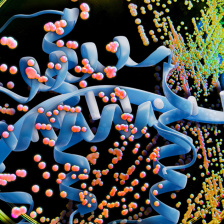
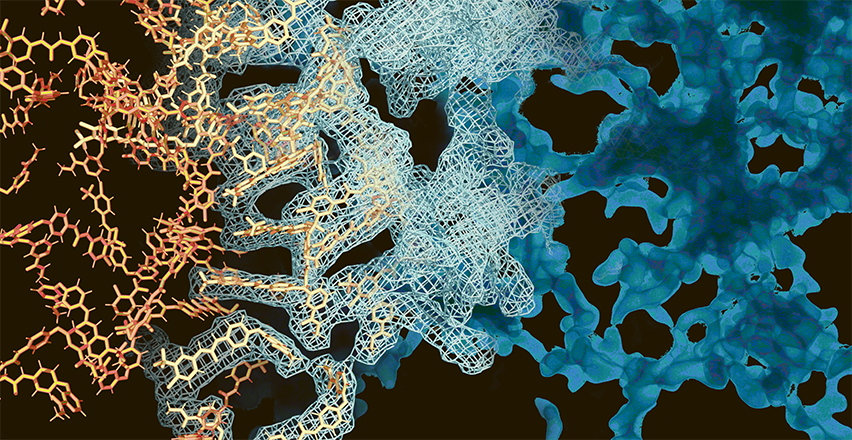
Many drugs, including the cancer therapy sorafenib pictured here, can spontaneously form intricate nano-scale structures that alter drug behavior. Researchers can use artificial intelligence techniques to predict what shapes these molecules will take under various conditions and design better versions of the drugs to improve patient outcomes. Credit: Daniel Reker
Artificial intelligence and machine learning (AI/ML) are powerful analytical engines that see patterns far beyond human capability. In the time it takes to review one patient’s chart, an AI can cross-reference millions of data points to predict how a specific immunotherapy interacts with a unique tumor microenvironment.
At the Koch Institute, our labs are generating data at a scale that demands this new kind of intelligence. By deploying AI/ML to navigate vast volumes of high-quality information, KI researchers are doing more than refining old answers. We are asking entirely new questions about the nature of cancer and how we might interrupt it.
Our approach focuses on engineering purpose-built models that translate effects across different biological systems, from the laboratory bench to the patient. These aren't the AI chat bots of daily life; these are expert-guided systems designed by MIT engineers and biologists to solve problems that once looked like science fiction, such as identifying tumors undetectable to current diagnostic technologies or determining a patient’s precise future risk for breast cancer.
To turn this predictive power into a permanent resource, we have established the Data Science and Multimodal Integration (DSMI) Core Facility. This centralized hub provides the advanced data science expertise and scalable GPU-based computing infrastructure needed to perform rigorous analysis on the most complex datasets in oncology. By integrating platforms from across the Institute, the DSMI ensures that our researchers are always working with the right data to build the right models.
In a field often overwhelmed by noise, our computational approaches provide the clarity needed to act. We are turning the vast complexity of cancer data into a precise instrument for discovery and a more direct path to the clinic. This is where the impossible becomes the predictable.