News

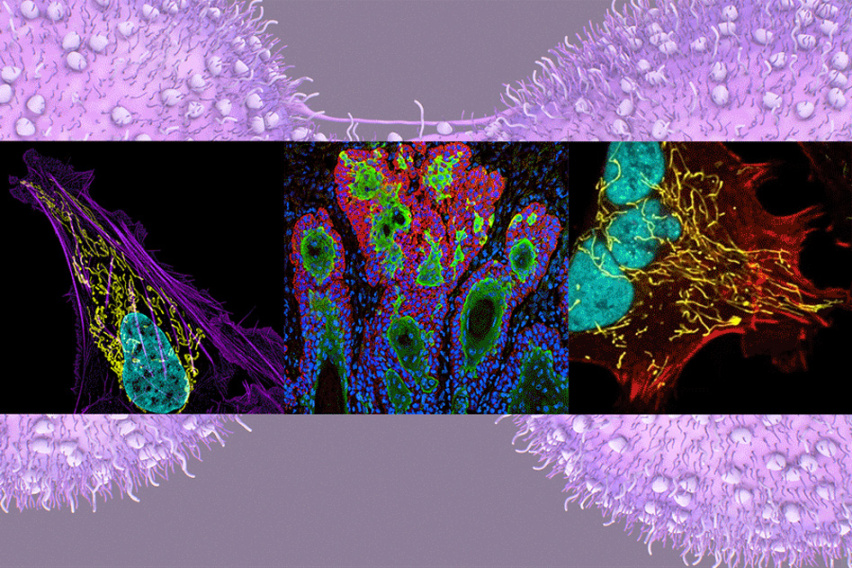
Two tumor cells, one with forcefield. two blue spheres with green and purple spheres on them

Kinase Closed: Shutting Down Cancer's Escape Routes

MIT News

Forest White and Cameron Flower PhD ’24 have uncovered why drugs that inhibit tyrosine kinase signaling pathways, such as imatinib (Gleevec), fail in some patients.  By analyzing tumor phosphoproteomics, the White Lab team found that many resistant cells are intrinsically wired to resist tyrosine kinase inhibitors: backup signaling networks are already running to support vital functions such as cell growth and division, even when tyrosine kinase inhibitors work as intended. 

As reported in Proceedings of the National Academy of Sciences, researchers overcame this resistance in cell models by pairing a tyrosine kinase inhibitor with a drug that targets the backup pathway—an approach currently in clinical trials for lung cancer. 

“We are really excited to watch these clinical trials and to see how well patients do on these combinations. And I really think there’s a future for using tyrosine phosphoproteomics to guide this clinical decision-making,” White says. The research was funded in part by the MIT Center for Precision Cancer Medicine.
 

Filter by

Filter by Title/Description

Filter by Topic

Filter by Year

Special Biops: Cell-Free DNAgents in the Field

MIT News

Liquid biopsies hold expanded potential for more and more patients, thanks to improved techniques developed by researchers at the KI, the Broad Institute of MIT and Harvard, Dana-Farber Cancer Institute, and MGH Cancer Center. By analyzing fragments of DNA expelled by cancer cells into the bloodstream, the team, led by Love Lab alumnus Viktor Adalsteinsson, was able to detect and profile the mutations present in these tumors, presenting a viable alternative to traditional biopsy sequencing. As shown in Nature Communications, their non-invasive “cell-free” approach offers particular promise for understanding metastatic cancer progression and treatment response in advanced disease states. The team’s initial work was supported in part by a TRANSCEND grant through the KI's alliance with Janssen Pharmaceuticals, Inc. 

Bait and Switch for Targeted Immunotherapy

MIT News

Researchers in the laboratory of KI member Timothy Lu have been working to develop targeted immunotherapies to attack cancer cells. Through the use of customized DNA/RNA sequences, the team has designed a synthetic gene circuit that is activated by transcriptional signals expressed by tumor cells, triggering a combinatorial immune response. Their bioengineered "switch" requires two cancer-specific signals to be present before it turns on, making it more accurate than current therapies, and can also be customized to recognize and target different cancer types.

Hynes Receives National Academy of Medicine Honor

National Academy of Medicine

Congratulations to KI member and Daniel K. Ludwig Professor for Cancer Research, Richard Hynes, for being named the recipient of the 2017 David Rall Medal from the National Academy of Medicine (NAM). Hynes was chosen for his leadership as the co-chair of the NAM/NAS Report Committee on Human Genome Editing. To honor his recent award, Hynes sat down with NAM to discuss his research, his inspiration for getting involved in policy work, and his thoughts on how to better engage public interest in science and medicine.

Heads Together for Brain Cancer

MIT News

Researchers from the Hemann, Lees, and Sharp laboratories joined forces in the fight against glioblastoma. Using a novel screen, the collaborative team identified PRMT5 as a protein involved in the tumors’ growth, and found that PRMT5 uses a special type of gene splicing to promote this growth.The researchers showed that inhibiting PRMT5 halted cancer cell growth in mice, and also identified a biomarker that could be used to predict which patients would benefit from treatment with existing PRMT5 inhibitors, at least one of which is currently in clinical trials for cancer. Their findings, described in Cancer Cell, help explain PRMT5’s poorly understood role in cancer and offer opportunities to improve current therapies and develop new ones. The team hopes to develop nanoparticles to help PRMT5 inhibitors cross the blood-brain barrier, and is also looking at PRMT5’s role in other tumor types.

This work was supported in part by the Koch Institute Frontier Research Program through the Kathy and Curt Marble Cancer Research Fund. Watch recent Lees Lab PhD recipient Monica Stanciu present this research as part of the Koch Institute’s SOLUTIONS with/in/sight: Fast-Moving Frontiers program.

New Academic Year Brings New KI Leadership

MIT Koch Institute

The Koch Institute is pleased to announce that KI faculty members Darrell Irvine and Matthew Vander Heiden have joined the Institute's leadership team as Associate Directors.

Irvine, Professor of Biological Engineering and Materials Science & Engineering, will step into this role to lead the Koch Institute's engineering initiatives and serve as a liaison with MIT's School of Engineering. Similarly, Vander Heiden, Associate Professor of Biology, will guide the KI's life sciences cohort and work closely with MIT's School of Science. With KI Director Tyler Jacks at the helm, Irvine and Vander Heiden join current Associate Director Jacqueline Lees, who has been an integral part of the leadership of the Koch Institute since its inception and of the Center for Cancer Research for six years before that. In addition to her continued involvment in all aspects of the administration, Lees will also continue to bring particular oversight to the 12 core facilities within the Swanson Biotechnology Center along with Sarah Farrington, Core Faciltities Administrator.

Dane Wittrup, who has served as Associate Director since the Koch Institute's founding in 2007, is stepping down from the leadership team. "I have very much enjoyed working with Dane in this capacity and thank him for his hard work and dedication," KI Director Tyler Jacks said. "I look forward to his continued contributions to the KI in the years ahead."

With fresh faces, new ideas, and sustained focus on representing our strengths in both engineering and life sciences, the 2017-2018 academic year is off to an exciting start at the KI!

A Strand-ing Ovation for mRNA Delivery

MIT News

Weaving together expertise in polymer science and chemical engineering with inspiration from nature, Hammond Lab researchers — as published in Angewandte Chemie — have designed a bioinspired delivery system for messenger RNA (mRNA) that is far more efficient than delivering these strands of genetic material on their own. mRNA holds great promise for treating disease, including cancer, but presents numerous challenges in delivering them to cells for high gene expression. The team's approach, attaching poly-A binding proteins to the mRNA tail and assembling the complex with a polymer, translates into more effective delivery to ribosomes for increased production of desired proteins. This work was supported in part by a Koch Institute Quinquennial Cancer Research Fellowship. 

Proceed with Caution: Hynes Gives Guidance Following Gene Editing Breakthrough

MIT News

KI faculty member Richard Hynes has been making the rounds of various media outlets to discuss implications of the announcement by Oregon Health & Science University researchers that they have successfully edited genes in human embryos to repair a mutation that causes a common and potentially deadly heart condition. Hynes, who co-chaired the National Academy of Sciences and National Academy of Medicine Study Committee that issued the Human Genome Editing Report earlier this year, appeared in The New York Times and on Charlie Rose to underscore the committee's initial recommendations about the important ethical and societal issues that need to be addressed in deciding what should and should not be allowed as additional technical challenges are overcome. 

The Proof is in the Proximity

MIT News

Anecdotal evidence abounds in support of the Koch Institute's position as a leader in collaboration at MIT, but we now have the quantitative data to prove it! A new study from MIT’s Department of Urban Studies and Planning, published in PLOS ONE, shows that the KI has the highest rate of intra-MIT co-authorship (roughly 32 percent) and the second highest rate of intra-MIT patent collaboration (27 percent). Both data points are a testament to the KI's success in bringing scientists and engineers together to encourage innovative and interdisciplinary approaches in cancer research. 

Converging on Cancer on the Nanoscale

MIT News

This summer, we mark the first anniversary of the launch of our Marble Center for Cancer Nanomedicine, established through a generous gift from Kathy and Curt Marble ’63. Bringing together leading Koch Institute faculty members and their teams, the Marble Center focuses on grand challenges in cancer detection, treatment, and monitoring that can benefit from the emerging biology and physics of the nanoscale. In its first year, the Center funded six transformative research projects in the areas of drug delivery and immunotherapy, established a scientific advisory board, and provided fellowship support for trainees, along with valuable opportunities for mentorship, scientific exchange, and professional development. We look forward to continued success and progress at the interface of nanotechnology and medicine.

The Life of a Pioneer

MedPage Today

Did you know that KI faculty member Robert Weinberg once built a cabin by hand in the woods of New Hampshire? Or that during the Civil Rights movement, he housed sharecroppers in Alabama who had been evicted from their land for registering to vote? Fascinating facts, that we enjoyed learning about in a recent article by MedPage Today. In the article, Weinberg — who is widely regarded as a cancer research pioneer for his discoveries of the first human oncogene, and the first tumor suppressor gene — talks about successes and setbacks over the course of his career, reflects on his tenure at MIT as a student, member of MIT's Center for Cancer Research (predecessor to the Koch Institute), and founding member of the Whitehead Institute.