News

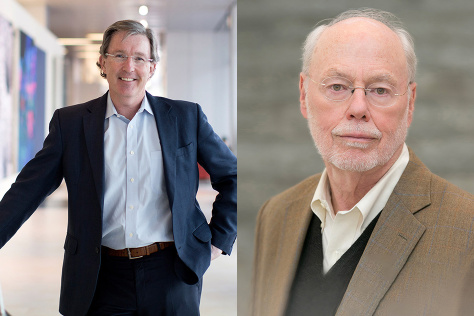
Photo of Tyler Jacks standing in front of a wall of colorful scientific images in the Koch Institute lobby and smiling for the camera.

Tyler Jacks Receives ACS Medal of Honor

American Cancer Society

Congratulations to Koch Institute Founding Director Tyler Jacks, who has been selected to receive the 2026 American Cancer Society Medal of Honor. The organization’s highest honor, this award is given to individuals whose work has fundamentally advanced the fight against cancer. Jacks is recognized for his extraordinary scientific contributions to the field of cancer biology as well as his leadership in shaping new, more effective models for collaborative, patient-centered research at MIT, non-profit Break Through Cancer, and the national level. 

Filter by

Filter by Title/Description

Filter by Topic

Filter by Year

Hojun Li Joins the KI

MIT Koch Institute

Welcome to Hojun Li, MD, PhD, the KI’s new Charles W. and Jennifer C. Johnson Clinical Investigator. A pediatric oncologist at Dana-Farber/Boston Children’s Hospital, he recently received a 2020 Scholar Award from the American Society of Hematology.

Dr. Li studies normal and pathologic hematopoietic stem cell development, conditions that predispose children and adults to leukemia, and novel treatments to prevent blood cancers in these patients.   

A Perfect 10 for 2020

MIT Koch Institute

The Koch Institute is ringing in the New Year with a 10/10—again! For more than a year, the Koch Institute community has been working on the renewal process for our Cancer Center Support Grant from the National Cancer Institute. Since MIT’s then-nascent Center for Cancer Research was distinguished as an NCI-designated Cancer Center in 1974, the grant has been recompeted every five years, requiring an extensive written application (more than 1,000 pages!) and an intense site visit. Given the vulnerability of federal research funding, there are no guarantees of success. Yet not only has the Koch Institute’s grant been formally approved for renewal, but it was given a perfect score of 10. We received the same score at our last recompete, in 2014. Join us in raising a glass to our faculty members, trainees, technicians, and staff who worked so hard to put the grant together and to defend it during the site visit!

Mind Your PNAS QnAs

MIT Koch Institute

PNAS queries Sangeeta Bhatia, director of the Marble Center for Cancer Nanomedicine, on her work building protease-based diagnostic tools, including probes—potentially delivered by a nebulizer—that distinguish between benign and malignant lung nodules. Other highlights include diagnostic tools for pneumonia and a rare genetic disease called α-1 antitrypsin deficiency.

Better Foundations for Breast Cancer Diagnostics

MIT Koch Institute

Foundation Medicine, co-founded by KI member Eric Lander, reports two advances in breast cancer diagnostics. The FDA approved the FoundationOne CDx test to select patients for treatment of HR+/HER2- breast cancer with PIK3CA mutations. In a clinical study, the company’s FoundationOne liquid biopsy test accurately predicted the risk of recurrence for early-stage triple-negative breast cancer. 

Homing in on Hypoxia

MIT Spectrum

Inspired by a desire to work on pressing, unaddressed medical needs, Cima Lab postdoc Greg Ekchian is developing a way to measure oxygen levels in tumors in order to improve cancer treatment. Until now, clinicians have been unable to quickly assess tumor tissue for areas of hypoxia (oxygen deprivation). Hypoxic areas can drive chemoresistance, but respond to high-dose radiation. Working with clinical collaborators through the Bridge Project, Ekchian is testing the strategy in a pilot trial of cervical cancer patients. In another project supported by the Koch Institute Frontier Research Program, he is developing a more advanced version of the original device.

KI Gets Two Therapeutic Thumbs Up

MIT Koch Institute

New startup Immunitas Therapeutics combines immunology and genetic targeting to stop tumors with a platform incorporating Bridge Project research by Aviv Regev, Mario Suvà, Dane Wittrup, and Kai Wucherpfennig. 

Sunflower Therapeutics will develop the Love lab’s nimble technology to dramatically reduce the time and cost to develop and manufacture biologics for patients around the world, from orphan diseases to areas without healthcare infrastructure. 

A Farewell to ARMS?

MIT News

Fusion-positive alveolar rhabdomyosarcoma (ARMS) is a rare, deadly, and poorly understood skeletal muscle cancer. Thanks, however, to a high-risk, high-reward grant from the Cancer Moonshot Initiative, this pediatric cancer faces a new adversary in KI member Angela Koehler. As part of a multi-institutional team, Koehler will use her signature microarray technology to screen for potential compounds that target the so-called “undruggable” fusion oncoproteins responsible for ARMS. The work is expected to open up new therapeutic opportunities for patients and inform drug development strategies for other challenging “orphan diseases.”

Here Be Dragonfly

MIT Koch Institute

Dragonfly, co-founded by KI director Tyler Jacks, launched its first clinical trial, a study of multiple solid tumor types, with a drug candidate called DF1001; the drug is the first from its TriNKET™ platform of NK cell-based immunotherapies to move into humans. The company also entered a partnership with AbbVie to help commercialize other candidates in its pipeline.

A Means to an End

MIT News

The Love and Shalek labs devised a high throughput single-cell RNA sequencing method for identifying T cells that share a particular target. Conventional RNA sequencing reads only one end of an RNA molecule. Yet, the variable sequences encoding for T cell receptors (TCR), which bind to receptors on target cells, reside on the other end. The new method, published in Nature Immunology and partly supported by the Bridge Project, complements the conventional approach by amplifying TCR-encoding RNA molecules labeled for their T cells of origin, then pulls and sequences them. The study identified T cells that produce inflammation in peanut allergies, but the technique can be applied to a variety of T cell responses, including patient responses to cancer immunotherapies.

Transforming Early Detection: More Than Meets the A.I.

MIT Koch Institute

KI member and computer scientist Regina Barzilay spoke with The New York Times and PBS’s FRONTLINE about how her own breast cancer diagnosis inspired her to use machine learning tools to empower physicians and patients alike. Working with physician Connie Lehman, Barzilay’s A.I. systems are improving mammography and enabling earlier detection—and prediction—of the disease.