News

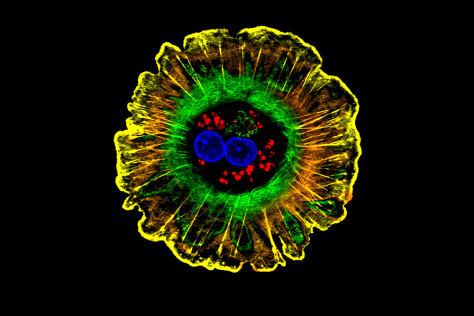
Two tumor cells, one with forcefield. two blue spheres with green and purple spheres on them

Kinase Closed: Shutting Down Cancer's Escape Routes

MIT News

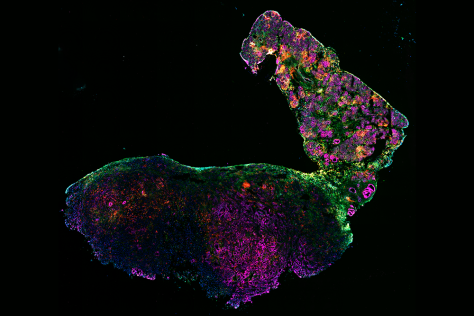
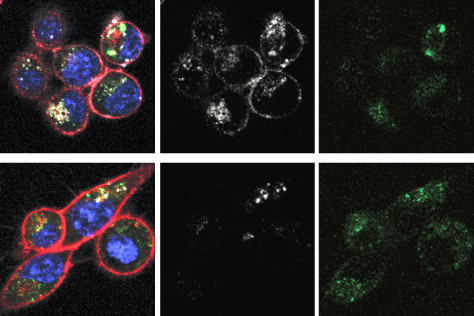
Forest White and Cameron Flower PhD ’24 have uncovered why drugs that inhibit tyrosine kinase signaling pathways, such as imatinib (Gleevec), fail in some patients.  By analyzing tumor phosphoproteomics, the White Lab team found that many resistant cells are intrinsically wired to resist tyrosine kinase inhibitors: backup signaling networks are already running to support vital functions such as cell growth and division, even when tyrosine kinase inhibitors work as intended. 

As reported in Proceedings of the National Academy of Sciences, researchers overcame this resistance in cell models by pairing a tyrosine kinase inhibitor with a drug that targets the backup pathway—an approach currently in clinical trials for lung cancer. 

“We are really excited to watch these clinical trials and to see how well patients do on these combinations. And I really think there’s a future for using tyrosine phosphoproteomics to guide this clinical decision-making,” White says. The research was funded in part by the MIT Center for Precision Cancer Medicine.
 

Filter by

Filter by Title/Description

Filter by Topic

Filter by Year

Swing States

MIT News

Analyzing the RNA expression patterns of cancer cells can reveal their susceptibility to different drugs, according to new work from Shalek and Manalis lab researchers and their Bridge Project collaborators. In a study of pancreatic cancer cells, published in Cell, the team also demonstrated that changes to the tumor microenvironment can drive cells from one RNA-expression state to another. Their findings suggest that it may be possible to treat some patients’ tumors more effectively by first modifying signals in the tumor microenvironment to lock it in a particular state, and then giving a drug that targets that state.

The work was funded in part by the Bridge Project and the Ludwig Center for Molecular Oncology at MIT.

Organ-ic Questions in Cancer Biology

MIT News

New KI faculty member Kristin Knouse studies regeneration in the liver to understand how tissues sense and respond to damage. As a clinically trained cell biologist, Knouse has a joint interest in medical applications and fundamental biological questions, including how seemingly dormant cancer cells drive metastatic disease.

More Powerful Vaccines

MIT News

A potent adjuvant from the Irvine Lab significantly improves antibody production in mice after vaccination against HIV, diphtheria, and influenza. The immune system-boosting nanoparticle, described in a study published in Science Immunology and funded in part by the Marble Center for Cancer Nanomedicine, may also have applications for vaccines against Covid-19 and cancer.

Standing Innovation

National Academy of Inventors

Congratulations to Paula Hammond on her election to the National Academy of Inventors Fellows Program. The program highlights academic inventors who have demonstrated a spirit of innovation in creating or facilitating outstanding inventions that have made a tangible impact on the quality of life, economic development, and the welfare of society.

Creating a Cohort

MIT News

Following on last year’s boot camp, the MIT Future Founders Initiative, initiated by KI members Sangeeta Bhatia, Susan Hockfield, and Nancy Hopkins, announced its $250K prize competition to promote female entrepreneurs in biotech. KI faculty members Laurie Boyer and Kristin Knouse are among the finalists, as is KI alum Canan Dagdeviren. Learn more about the program's origins and goals in Bhatia's recent interview with the Kendall Square Association.

Mirai Goes Global

STAT News

Mirai, a machine learning model for breast cancer risk prediction, is heading to seven hospitals around the world. Researchers hope to minimize Mirai’s bias by testing its performance in patient populations with diverse clinical and demographic backgrounds. The model was developed by a team led by KI member Regina Barzilay and was recently featured in The Washington Post and on Good Morning America.

Immune Cell Masquerade

MIT News

Spranger Lab researchers describe how a subset of immune cells known as type-2 conventional dendritic cells (DC2) cloak themselves in cancer-associated proteins to provoke an immune response against tumors. Their findings, published in Immunity, indicate that these stealthy operations are driven by the signaling molecule type-1 interferon, suggesting new strategies for targeted immunotherapy.

Moderna Man

Forbes

Nature Biotechnology has named KI faculty member and Moderna co-founder Robert Langer among the top 20 translational researchers of 2020. In an interview with Forbes contributor Jack Kelly, Langer discusses his career path from struggling graduate student to MIT Institute Professor, reflecting on the the importance of mentorship, dreaming big, and learning how to deal with failure.

Stem Cells Loom Large as Aging Factor

MIT News

New research from the Amon Lab suggests that size is an important factor in cellular aging. The study, supported in part by the MIT Stem Cell Initiative and published in Science Advances, showed that blood stem cells grow larger as they age, and that as they grow in size, they become less able to generate new blood cells.

Fundamentally Curious

MIT Koch Institute

“The best science comes from those who are fundamentally curious.” So reads new lettering in the west wing of the Koch Institute Public Galleries, alongside a dedicated plaque celebrating the life and work of Angelika Amon. The unveiling ceremony, attended by Angelika’s family and close colleagues, also debuted a new exhibit celebrating MIT’s rich legacy of discovery science—an endeavor near and dear to Angelika’s heart—and announced the creation of the Amon Young Scientist Award to support exchange of ideas between MIT and international researchers.