

Bendta Schroeder, MIT Koch Institute
August 6, 2026
A master regulator of lineage plasticity could be the key to identifying and treating aggressive colorectal cancers
Colorectal cancer is among the most common and deadly cancers: it is the second most common cause of cancer deaths and is expected to account for around 55,000 in 2026. If caught early, patients have an excellent chance of survival (around 90%). Most colorectal cancer deaths occur after the cancer has metastasized, usually to the liver.
Recent advances in chemotherapy and immunotherapies have improved the outlook for some patients with colorectal cancer, yet very few patients with liver metastases achieve complete remission. The development of new drugs to treat liver metastases may be key to improving survival rates for these patients. However, finding new drug targets for the treatment of metastatic colorectal cancers has proven difficult since metastasis does not appear to be driven by new mutations as it is in many other cancers.
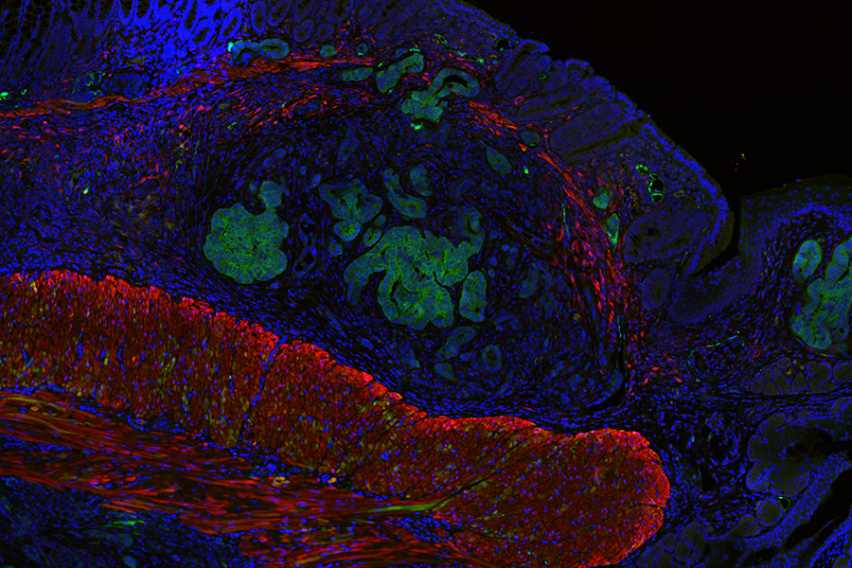
To uncover the mechanism driving colorectal cancer’s spread, researchers from MIT and Weill Cornell Medicine carefully traced the molecular developments in metastatic cells as they became progressively more aggressive. They discovered that the culprit behind liver metastasis is GATA6, a protein that controls which genes are turned on or off. Normally, this transcription factor helps cells lining the intestine maintain a stable, well-defined identity. In a study recently appearing in Cell Stem Cell, the team showed that as cancer cells lose GATA6, they evolve into more stem cell-like, adaptable states that can spread to the liver and establish new tumors.
Senior authors of the study are Ömer Yilmaz, professor of biology and member of MIT’s Koch Institute for Integrative Cancer Research, and Norihiro Goto, a former postdoc in the Yilmaz lab and current assistant professor at Weill Cornell Medicine.
At the beginning of their search, the researchers built a library of organoids — miniature three-dimensional tumors grown in a dish — using metastatic liver cells from mice that were better able to spread. The organoids were transplanted back into the colon of mice, creating more aggressive tumors that metastasized to the liver.
Over three successive rounds of the process, the researchers built and compared profiles of gene expression and regulatory activity of the increasingly metastatic cancer cells. They found that the cancer cells shed their normal identity as colon stem cells and progressively reawaken programs normally seen in the gut during fetal development or in the continuously renewing squamous tissues that line various structures in the body, such as skin or esophagus.
While changes to the gene regulatory and expression programs were widespread, they converged on the loss of a single master regulator: the transcription factor GATA6. As tumor organoids grew more metastatic with each round of implantation, GATA6 was progressively switched off. This effect was supported by the researchers’ observation that when they deleted GATA6 from colon cancer cells, the cells became dramatically better at seeding liver metastases. Because primary tumors without GATA6 grew no faster than usual, researchers were able to conclude that the transcription factor specifically unlocks spread rather than growth. The pattern held in samples derived from patients: GATA6 was abundant in most primary tumors but largely absent in liver metastases, and low GATA6 predicted worse survival.
Further, the researchers discovered that GATA6 loss in colorectal cancer cells induced lineage plasticity, a cell's ability to change its identity and behavior. Normally, GATA6 blocks multiple avenues to lineage plasticity, sustaining a cell’s identity as a colon and a stem cell and preventing its reversion to a fetal-like cell.
Once GATA6 is removed, tumor cells adopt alternative gene programs that allow them to transform into fetal-like cells that can escape from the primary tumor into the bloodstream and colonize other organs.
"GATA6 acts like one brake on several escape routes at once — it keeps the cancer cells in their normal colonic identity,” explained Yilmaz. “When you take it away, they reawaken the fetal-like and squamous programs that let them spread. Most other factors we know about control just one of these programs; GATA6 sits above all of them.”
The study suggests that GATA6 loss could serve as a biomarker for metastatic risk, allowing clinicians to identify patients needing closer surveillance and more aggressive treatment. Moreover, the findings suggest that the loss of GATA6 could be used to develop strategies to prevent or slow metastasis in colorectal cancer.
“The work highlights a potential therapeutic approach that stabilizes cell identity or prevents cancer cells from entering flexible, pro-metastatic states,” Goto said. “The challenge will be targeting plasticity therapeutically without disrupting tissue repair processes, which rely on similar programs.”
In the future, the researchers plan to identify weaknesses unique to GATA6-deficient cancer cells that could be targeted with new therapies. They will also explore how the tumor microenvironment, including interactions with immune cells and liver-specific signals, may influence cell transitions.
The study was funded in part by the MIT Stem Cell Initiative via Fondation MIT and the Bridge Project, a partnership between the Koch Institute for Integrative Cancer Research at MIT and the Harvard Cancer Consortium.