

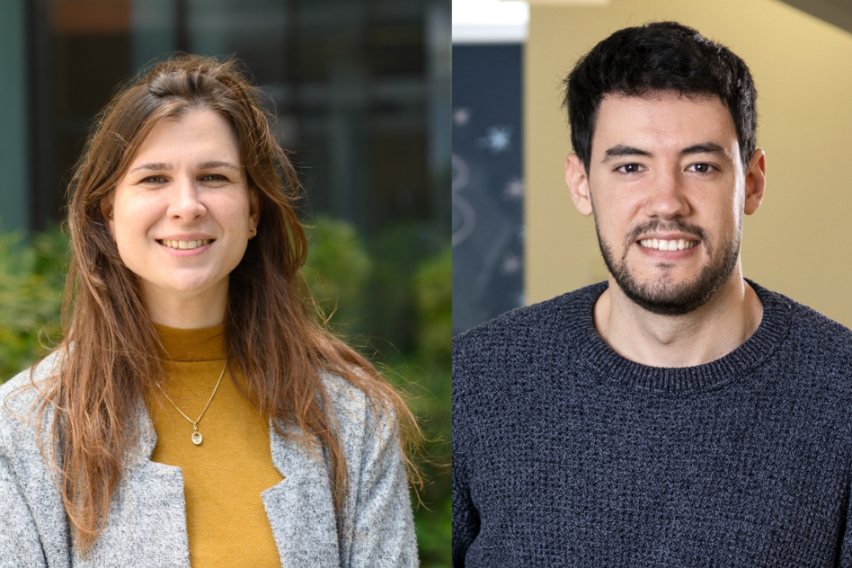
Karin Goldberg (left) and Rubén López Sandoval
MIT Koch Institute
September 8, 2026
Congratulations to the winners of the 2026 Angelika Amon Young Scientist Award: Rubén López Sandoval of ETH Zurich, and Karin Goldberg of the Weizmann Institute of Science.
Established in 2021, the prize recognizes graduate students in the life sciences or biomedical research from institutions outside the United States who embody Dr. Amon's excellence in research and infectious enthusiasm for discovery science.
López is a PhD candidate in the Doctoral Program for Translational Engineering of Biological Systems at ETH Zurich and the Institute of Human Biology , where he works under the joint supervision of Gray Camp and Randall Platt. He engineers bioprinted hydrogel scaffolds that recreate the human small intestine and colon, including intestinal crypts. The resulting luminally accessible, immunocompetent models feature mature epithelium, a mucus layer, and autologous tissue-resident memory T cells. Using single-cell multiomics, he showed that these engineered barriers closely mirror the native organ across dozens of donors, then applied the platform to two pathogens of the small intestine. In Salmonella Typhimurium infection, his work identified STAT3 as a master regulator of invaded epithelial cells and uncovered an epithelium-to-T cell signaling axis that, via IL-18, drives tissue-resident-specific cytotoxic clearance of the intracellular pathogen. In a second study, he used the model to reveal host-driven biofilm formation and gene expression changes in Vibrio cholerae that are invisible in standard liquid culture. This work, currently revised and resubmitted at Nature, establishes a modular new platform for studying human gut physiology, host-pathogen interactions, and disease.
Goldberg is a PhD candidate in the Systems Immunology Department at the Weizmann Institute of Science, working under the supervision of Yifat Merbl. Goldberg's doctoral research asks a fundamental question: do the peptide byproducts of proteasomal protein degradation have biological functions beyond their known roles in maintaining protein homeostasis and generating peptides for antigen presentation? Pursuing this question led to an unexpected discovery, published in Nature (2025): bacterial infection triggers a functional and compositional remodeling of the proteasome — driven by recruitment of the regulator PSME3 — that generates a distinct class of proteasome-derived defense peptides (PDDPs) with potent, broad-spectrum antimicrobial activity. Goldberg showed that these peptides protect against lethal sepsis in mouse models, revealing a previously unrecognized layer of cell-autonomous innate immunity and opening a new avenue for peptide-based antimicrobial therapeutics.
The KI and MIT communities and Amon Lab alumni, are invited to attend Goldberg’s presentation of her research at the Amon Award ceremony on Thursday, October 29, 2026 at 2:00 p.m. in the Luria Auditorium, with a reception to follow at 3pm in the Koch Institute Public Galleries. Goldberg will present on “Beyond Protein Breakdown: New Insights into Proteasomal Degradation in Innate Immunity.”
López will join us next fall to present his work alongside the 2027 Amon Award winners.