

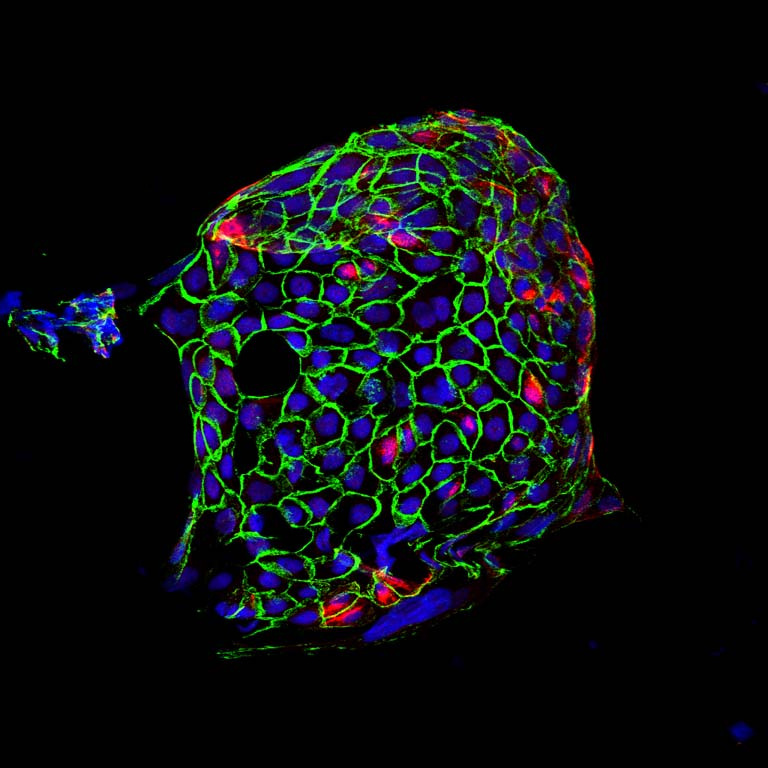
Engineered by the Koch Institute’s Jacks Lab to carry mutations in Kras and Tp53, two commonly perturbed genes in pancreatic cancer, organoid models like this one support studies of tumor development, progression, and therapeutic response.
When it received FDA approval in August 2026, daraxonrasib nabbed headlines as a long-awaited breakthrough treatment for pancreatic cancer, with potential against other tumors driven by RAS mutations. Yet, despite its performance and promise, some patients are already developing resistance.
Using their signature phosphoproteomics approaches in cell lines and xenograft tumors, White Lab researchers have been working with collaborators at Mass General Brigham to investigate mechanisms behind this resistance. In their pre-clinical experiments they saw, from 1-3 days post treatment, the upregulation of a survival pathway that centers on signaling proteins called Src family kinases. When they combined Src kinase inhibitors with daraxonrasib they saw a highly synergistic effect that White described as being “like bleach—there’s almost no cells left.”
Inspired by the results, White and his team connected with Harshbad Singh, a clinician at Mass General Brigham, then with Nuvectis Pharma, which is developing the Src inhibitor used in the team’s experiments, to organize a clinical trial of the daraxonrasib-Src inhibitor combination.
Meanwhile, at New York’s Cold Spring Harbor Laboratory, a research group led by Dave Tuveson, an alum of the Koch Institute’s Jacks Lab, had identified the same survival pathway as a KRAS inhibitor resistance mechanism using a different research approach, one based on CRISPR screening. Jacks recognized the overlap and connected White and Tuveson at a scientific meeting.
The resulting human synergy parallels the pharmaceutical one uncovered by White and his team. He and Tuveson have now cosubmitted papers to Cancer Research, which are in revision and expected to be published together. Additionally the Nuvectis trial, while still led by Singh, has been expanded to include Tuveson’s team, as well as clinicians and sites at Northwell Health, New York’s largest healthcare provider.
The trial, which will test Src kinase inhibitors with daraxonrasib combinations in patients with pancreatic cancer, is expected to begin in late 2026.