News

Headshot of Richard Hynes, sitting in front of a bookcase

Remembering Richard Hynes

MIT Koch Institute

With great sadness, the Koch Institute marks the passing of Richard O. Hynes PhD ’71, whose discoveries reshaped modern understandings of how cells interact with each other and their environment, who died January 6, 2026 at age 81.

Filter by

Filter by Title/Description

Filter by Topic

Filter by Year

Remembering Richard Hynes

MIT Koch Institute

With great sadness, the Koch Institute marks the passing of Richard O. Hynes PhD ’71, whose discoveries reshaped modern understandings of how cells interact with each other and their environment, who died January 6, 2026 at age 81.

From Nematode to Nobel

McGovern Institute

Why study worms? H. Robert Horvitz, David H. Koch (1962) Professor of Biology, with several notable former trainees and fellow Nobel laureates, makes the case in a recent PNAS paper. They highlight critical discoveries—spanning normal biology, gene regulation, and diseases including cancer—as well as research tools for imaging that have emerged from studies of a microscopic roundworm, and emphasize the community spirit and resource sharing that enabled and continue to enable this work.

Forest White Honored with Committed to Caring Award

MIT News

Congratulations to Forest White on receiving MIT’s Committed to Caring Award! This graduate student‑nominated honor recognizes faculty members whose mentorship fosters resilience, curiosity, and compassion, having a lasting impact on students’ academic and personal journeys. Forest joins 18 honorees exemplifying exceptional care and guidance in the MIT community.

How does high fat diet drive tumors?

MIT News

A new Cell study from the Shalek and Yilmaz labs suggests liver cells exposed to too much fat—via high fat diet—revert to an immature state that is more susceptible to cancer-causing mutations. Partly supported by the MIT Stem Cell Initiative, the researchers showed that chronic metabolic stress causes individual liver cells to prioritize their own survival over activities important for the tissue and organ as a whole; they also uncovered specific molecular mechanisms by which this occurs.

The Koch Institute's Top Research Stories of 2025

MIT Koch Institute

As the year draws to a close, we’re excited to spotlight some of the most innovative and impactful research from the Koch Institute this year. 

NIH Director Jay Bhattacharya Visits MIT

MIT News

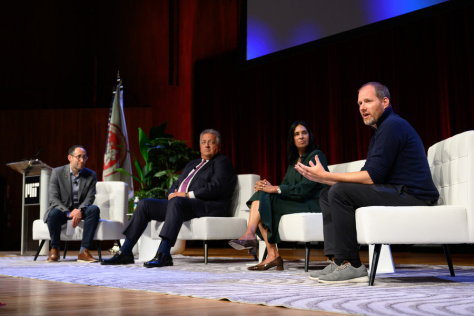
National Institutes of Health Director Dr. Jay Bhattacharya joined Rep. Jake Auchincloss at MIT for a wide‑ranging discussion on NIH’s "unified strategy" for reviewing grant applications, the importance of idea generation and rigorous testing, and support for early‑career scientists amid changes in grant review processes.

New immunotherapeutic targets for glioblastoma

MIT Koch Institute

Immunotherapies have not proven effective in glioblastoma, a common form of brain tumor that is unusually resistant to infiltration and attack by T cells. Glioblastoma tumors recruit and transform another immune cell, macrophages, to keep T cells at bay. Researchers led by Forest White mapped antigen profiles of macrophages and glioblastoma cells in co-culture, discovering that both types of cells evolved when grown together and identifying several new targets for immunotherapies. The team, which included Stefani Spranger and former KI member Darrell Irvine, developed immunostimulatory therapies to test six candidate target, finding that mouse models of glioblastoma showed significantly slowed tumor growth overall and, in a few cases, tumors were completely eradicated.  The study, published in Cancer Research was funded in part by the MIT Center for Precision Cancer Medicine.

Introducing the 2025 Karches Prize winners

Congratulations to the winners of the 2025 Peter Karches Mentorship Prize: Fangtao Chi, Emma Dawson, Amy Lee, and Richard Van. The Peter Karches Mentorship Prize is awarded annually to up to four Koch Institute postdocs, graduate students or research technicians who demonstrate exemplary mentorship of undergraduate researchers or high school students in their labs. The prize allows the Koch Institute community to celebrate and recognize the critical role that mentors play, both personally and professionally, in the early stages of a scientist’s career.

Accelerated FDA approval for kidney drug

Endpoints News

Congratulations to Ram Sasisekharan on the accelerated FDA approval of the drug sibeprenlimab for treating IgA nephropathy (IgAN), a disease where the build-up of abnormal antibodies impedes the kidney’s ability to filter wastes and often leads to kidney damage and failure. Based on work in the Sasisekharan lab and developed by MIT spin-out Visterra (later acquired by the pharmaceutical company Otsuka), the new drug halves the amount of protein present in urine by targeting a ligand known as APRIL. Continued approval depends on trial data confirming the drug slows the decline of kidney function, due in early 2026.

Alice Hall Named Rhodes Scholar

MIT News

Congratulations to Alice Hall on being named a 2026 Rhodes Scholar! A senior majoring in chemical engineering, Hall (pictured, second from left) worked in the Langer Lab to improve lung viability for transplantation by investigating alveolar-capillary barrier function. At Oxford, she will pursue graduate work advancing sustainable heating and cooling technologies