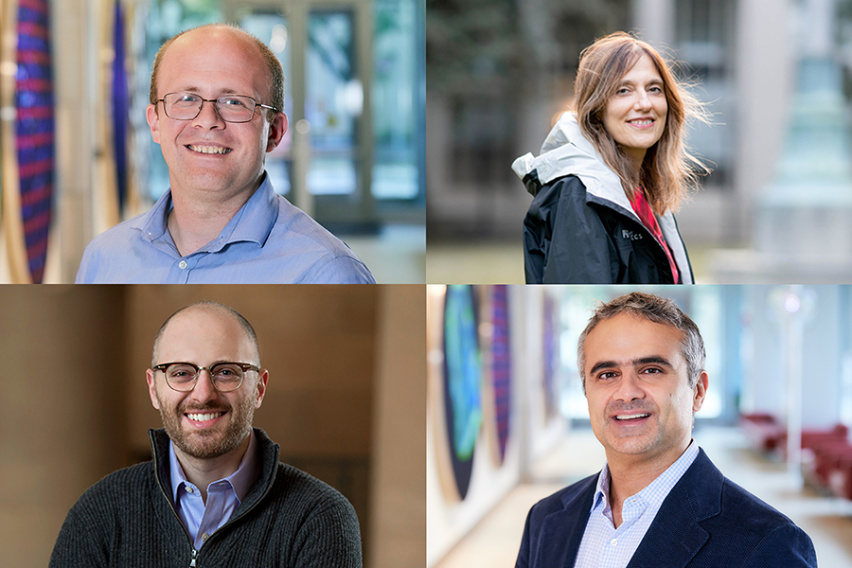
The MIT PS-OC is collaboration among MIT, Harvard University, University of California San Francisco, Harvard Medical School, Boston University, Hubrecht Institute, and Brigham and Women's Hospital. It is one of twelve Physical Sciences in Oncology Centers awarded by the National Cancer Institute (NCI), part of the National Institutes of Health (NIH). The overarching goal of this team is to use both theoretical and experimental approaches inspired by Physics and Engineering to attack important problems in cancer biology by developing novel technology and analytical and computational methods to track the dynamics of cancer at the single cell level.
Research in our center is focused on the following projects.
Project 1: The general objective of this project, led by Dr. Alexander van Oudenaarden, is to develop quantitative models of stem cell differentiation and reprogramming by obtaining absolute measurements of the transcript abundance in individual stem cells and their progeny in healthy tissue and cancer. Two complementary experimental systems will be explored: the intestinal epithelium and induced pluripotent stem cells.
Project 2: The central theme of this project, led by Dr. Arup Chakraborty, is to employ complementary theoretical and experimental studies at the crossroads of the physical and life sciences to deconvolute the origins of aberrant Ras signaling in the context of a specific T cell lymphoma observed in the clinic. We will especially try to understand the mechanisms underlying our recent observation of complex and heterogeneous responses.
Project 3: The replication and segregation of the genome (the cell cycle) and the increase in bio-mass of individual cells (cell growth) must be coordinated in all cells. Many tumor suppressors and oncogenes can alter the normal balance between growth and division and some cancers are characterized by abnormal cell size. The goal of this project, led by Dr. Scott Manalis, is to deconvolve cell growth and the cell division cycle, determine the molecular basis for the coordination of these two processes, and determine how these two processes and their coordination are altered in cancer.
Project 4: The development of cancer can be considered as an evolutionary process within an organism. During neoplastic progression, cells acquire mutations, compete for resources, and are subject of selection for ability to grow fast in a complex and dynamic environment. The goal of the project, led by Dr. Leonid Mirny, is to develop a theory of neoplastic evolution informed by cancer genomic and experimental data; use it as a framework for characterization of driver and passenger mutations by original statistical techniques, and to test feasibility of pushing a cancer into a population meltdown due to elevated mutation load.
Information about the PS-OC Network is available online:
Physical Sciences in Oncology
NCI Alliance for Nanotechnology in Cancer
Alexander van Oudenaarden
Professor of Physics
Professor of Biology
Massachusetts Institute of Technology
Arup Chakraborty
Robert T. Haslam Professor of Chemical Engineering
Professor of Chemistry
Professor of Biological Engineering
Massachusetts Institute of Technology
Scott Manalis
Associate Professor of Biological and Mechanical Engineering
Massachusetts Institute of Technology
Leonid Mirny
Associate Professor of Health Sciences and Technology and Physics
Massachusetts Institute of Technology
Angelika Amon
Professor of Biology
Massachusetts Institute of Technology
Gad Getz
Broad Institute of MIT and Harvard
Tyler Jacks
Director, Koch Institute for Integrative Cancer Research
David H. Koch Professor of Biology
Massachusetts Institute of Technology
Rudolf Jaenisch
Whitehead Institute
Professor of Biology
Massachusetts Institute of Technology
Mehran Kardar
Professor of Physics
Massachusetts Institute of Technology
Benjamin Braun
UC San Francisco
Hans Clevers
Hubrecht Institute
University Medical Center Utrecht
Marc Kirschner
Harvard Medical School
Jeroen Roose
UC San Francisco
Kevin Shannon
UC San Francisco
Michael Sherman
Boston University School of Medicine
Shamil Sunyaev
Harvard Medical School
Hanna, J., Saha, K., Pando, B., van Zon, J., Lengner, C. J., Creyghton, M. P., van Oudenaarden, A., and Jaenisch, R. Direct cell reprogramming is a stochastic process amenable to acceleration. Nature 462: 595 (2009).
New Insights into Pluripotent Stem Cell Development
December 3, 2009
Cancer research gets physical
October 27, 2009